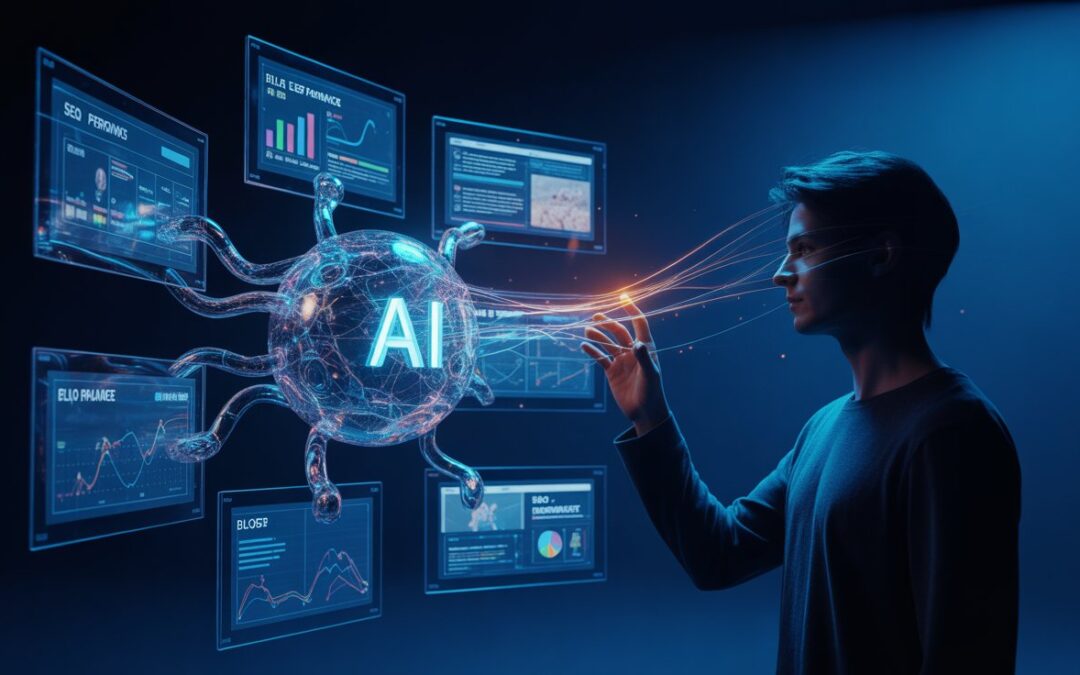
AI Marketing Trends 2026: The Complete Guide to the Future of Marketing
AI Marketing Trends 2026 are transforming how businesses plan campaigns, create content, improve customer experiences, generate leads, and increase ROI. From AI agents and predictive analytics to Answer Engine Optimization, AI search, automation, and personalization, artificial intelligence is becoming a core part of modern marketing.
Table of Contents
What Is AI Marketing?
AI marketing is the use of artificial intelligence technologies to improve marketing planning, execution, measurement, and optimization. It helps businesses understand customers better, automate repetitive tasks, personalize messages, and make faster data-driven decisions.
In simple words, AI marketing allows businesses to use data and automation to deliver the right message to the right customer at the right time. This is why AI Marketing Trends 2026 are becoming important for every business, from startups and agencies to eCommerce brands, training institutes, SaaS companies, and local service providers.
Quick Answer: The most important AI Marketing Trends 2026 include Answer Engine Optimization, AI search optimization, AI agents, predictive marketing, AI-powered content creation, conversational AI, AI video marketing, hyper-personalization, and ethical AI marketing.
Why AI Marketing Is Growing So Fast
AI marketing is growing because customers now expect faster responses, personalized experiences, useful content, and smooth buying journeys. At the same time, businesses are handling more data, more platforms, and more competition than ever before.
Traditional marketing methods are no longer enough. Marketers must now analyze customer behavior, track campaigns, create content, manage ads, respond to leads, and measure ROI across multiple channels. AI helps simplify this process.
Main Reasons Behind AI Marketing Growth
- Businesses need faster campaign execution.
- Customers expect personalized experiences.
- Marketing teams want better data insights.
- AI search engines are changing how people discover brands.
- Automation reduces manual work.
- Competition in digital marketing is increasing.
Businesses that already invest in digital marketing training can gain an advantage by learning how AI tools support SEO, Google Ads, social media, analytics, email marketing, and content marketing.
15 Top AI Marketing Trends 2026
1. Answer Engine Optimization
Answer Engine Optimization, also called AEO, is one of the biggest AI Marketing Trends 2026. Traditional SEO focuses on ranking web pages on search engines. AEO focuses on helping your content appear in AI-generated answers.
People are now using ChatGPT, Gemini, Perplexity, Copilot, and Google AI Overviews to get direct answers. This means businesses must create clear, helpful, structured, and trustworthy content that AI systems can understand and reference.
How to Optimize for AEO
- Use question-based headings.
- Add short answers after important headings.
- Create FAQ sections.
- Use schema markup.
- Write clear definitions and examples.
- Build topical authority through related blogs.
2. AI Search Optimization
AI search optimization is becoming essential because user search behavior is changing. Instead of typing short keywords, people now ask detailed questions in conversational language.
For example, instead of searching “best CRM,” a user may ask, “What is the best CRM for a small business with email automation and low monthly cost?” This shift requires businesses to create deeper, more specific, and more helpful content.
To improve AI search visibility, businesses should follow strong SEO practices from trusted resources like Google Search Central and create content that directly answers customer questions.
3. AI Agents in Marketing
AI agents are advanced tools that can complete marketing tasks with minimal manual input. They can analyze reports, summarize campaign performance, suggest optimizations, monitor KPIs, and help teams make faster decisions.
In 2026, AI agents are moving from basic assistance to active marketing operations. They can help with campaign planning, lead scoring, customer support, content workflows, and analytics.
AI Agent Use Cases
- Automated marketing reports
- Campaign performance monitoring
- Lead scoring and qualification
- Customer support automation
- Content planning and research
4. Hyper-Personalization at Scale
Hyper-personalization uses AI to deliver customized messages, offers, product recommendations, and website experiences based on user behavior and preferences.
This goes beyond using a customer’s name in an email. AI can personalize content based on browsing history, purchase behavior, location, device, interest, and engagement level.
5. Predictive Marketing
Predictive marketing uses AI and data analytics to forecast customer behavior. It helps businesses understand which leads are likely to convert, which customers may stop buying, and which campaigns may perform better.
This allows businesses to spend more time and budget on the right audience instead of guessing.
| Predictive Marketing Area | Business Benefit |
|---|---|
| Lead Scoring | Focus on high-quality leads |
| Churn Prediction | Reduce customer loss |
| Sales Forecasting | Plan better campaigns |
| Customer Segmentation | Improve targeting |
6. AI-Powered Content Creation
AI-powered content creation is one of the most widely adopted AI marketing trends. Businesses use AI tools to create blog outlines, social media captions, email copy, product descriptions, ad copy, landing page content, and video scripts.
However, AI content should not be published without human review. The best strategy is to use AI for speed and humans for expertise, originality, accuracy, and brand tone.
Best Practice
- Use AI for research and first drafts.
- Add human experience and examples.
- Check facts before publishing.
- Optimize content for SEO and readability.
- Maintain brand voice.
7. AI Video Marketing
AI video marketing is growing quickly because businesses need more video content for social media, ads, websites, and product education. AI tools can now help create scripts, voiceovers, avatars, captions, edits, and short-form videos.
This helps brands create more content with lower production time and cost. AI video is especially useful for product demos, explainer videos, reels, YouTube Shorts, and ad creatives.
8. Conversational AI
Conversational AI includes chatbots, AI assistants, WhatsApp automation, website chat, and voice assistants that communicate with customers in real time.
Modern AI chatbots can answer questions, recommend products, qualify leads, book appointments, and support customers 24/7. This improves customer experience and reduces response delays.
9. AI-Powered Advertising
AI is changing paid advertising across Google Ads, Meta Ads, LinkedIn Ads, and programmatic platforms. AI helps advertisers optimize bids, test creatives, identify audiences, and improve campaign performance.
Businesses running paid campaigns should also learn proper campaign structure, conversion tracking, landing page optimization, and analytics. A practical Google Ads course can help marketers understand how to use AI-powered ads more effectively.
10. First-Party Data Intelligence
Privacy changes are making first-party data more valuable. First-party data is collected directly from customers through forms, CRM systems, purchases, subscriptions, surveys, and website interactions.
AI helps businesses analyze this data to understand customer needs, predict behavior, segment audiences, and personalize campaigns.
Tools like Google Analytics help marketers understand traffic sources, user behavior, conversions, and campaign performance.
11. AI Email Marketing
AI email marketing helps businesses improve subject lines, send times, audience segmentation, personalization, and automated follow-up sequences.
For example, AI can identify when a user is most likely to open an email or which product they may be interested in based on past behavior.
12. AI-Powered Customer Journey Mapping
Customer journey mapping helps businesses understand how customers move from awareness to conversion. AI can analyze multiple touchpoints such as ads, website visits, emails, chat interactions, and purchases.
This helps marketers identify where customers drop off and what actions can improve conversions.
13. AI-Driven Marketing Analytics
Marketing analytics is becoming smarter with AI. Instead of manually preparing reports, marketers can use AI dashboards and analytics tools to get real-time insights and recommendations.
AI can help answer questions like which campaign generated the best ROI, which channel brought quality leads, and what budget changes can improve results.
14. Multimodal Marketing
Multimodal marketing uses different content formats such as text, images, video, audio, and interactive media. AI tools now make it easier to create and repurpose content across multiple formats.
For example, one blog can become a social media post, video script, infographic, email newsletter, and podcast outline.
15. Ethical AI Marketing
Ethical AI marketing is becoming more important as businesses use customer data and automation. Brands must be transparent about data usage, avoid misleading content, protect privacy, and review AI-generated materials carefully.
Trust is a major part of future marketing. Businesses that use AI responsibly can build stronger customer relationships.
AI Marketing Trends 2026 Comparison Table
| AI Marketing Trend | Main Benefit | Best For |
|---|---|---|
| Answer Engine Optimization | Visibility in AI answers | Blogs, SaaS, education, agencies |
| AI Agents | Automated marketing operations | Marketing teams and agencies |
| Predictive Marketing | Better decision-making | Lead generation and eCommerce |
| AI Content Creation | Faster content production | Content teams and businesses |
| Conversational AI | Faster customer support | Service businesses and websites |
| AI Video Marketing | More engaging content | Social media and ads |
Best AI Marketing Tools in 2026
Businesses can use different AI marketing tools depending on their goals. Some tools help with content, while others support analytics, CRM, design, advertising, and automation.
| Tool | Purpose |
|---|---|
| ChatGPT | Content ideas, research, outlines, strategy, and automation support |
| Gemini | AI search, research, and productivity |
| Claude | Long-form content and document analysis |
| HubSpot AI | CRM automation and marketing workflows |
| Jasper | Marketing content and copywriting |
| Canva AI | Design, social media creatives, and visual content |
For broader digital marketing insights, businesses can also follow resources like Think with Google and the HubSpot State of Marketing report.
Challenges of AI Marketing
AI marketing has many benefits, but businesses must also understand its challenges. AI tools are powerful, but they are not perfect. They need proper data, human review, clear strategy, and ethical usage.
Common AI Marketing Challenges
- AI-generated content may contain inaccurate information.
- Poor data quality can lead to poor decisions.
- Privacy and compliance rules must be followed.
- Teams need training to use AI tools properly.
- Over-automation can reduce human connection.
Future of AI Marketing Beyond 2026
The future of AI marketing will focus on autonomous systems, predictive customer journeys, real-time personalization, AI-powered search, and intelligent marketing operations.
AI will not replace marketers completely. Instead, marketers who understand AI will become more valuable because they can combine creativity, strategy, technology, and data-driven decision-making.
How Businesses Can Prepare for AI Marketing Trends 2026
To prepare for AI Marketing Trends 2026, businesses should start by identifying where AI can save time, improve quality, or increase ROI. They should not use AI only because it is trending. AI should support clear business goals.
- Audit your current marketing process.
- Identify repetitive tasks that can be automated.
- Train your team on AI tools.
- Create a first-party data strategy.
- Optimize content for SEO and AEO.
- Use AI for reporting and insights.
- Review all AI-generated content before publishing.
- Track results and improve continuously.
For businesses focused on organic visibility, learning through an SEO course can help them understand keyword research, content optimization, technical SEO, local SEO, and AI search readiness. Similarly, brands using social platforms should strengthen their content and campaign skills through a social media marketing course.
Key Takeaways
- AI Marketing Trends 2026 are changing SEO, content, ads, analytics, and customer experience.
- Answer Engine Optimization is becoming important for AI-powered search visibility.
- AI agents are helping marketers automate reports and campaign decisions.
- Predictive marketing improves targeting and budget planning.
- AI content creation is useful, but human review is still necessary.
- Ethical AI marketing builds trust and long-term brand value.
FAQs About AI Marketing Trends 2026
What are AI Marketing Trends 2026?
AI Marketing Trends 2026 include Answer Engine Optimization, AI search optimization, AI agents, predictive marketing, conversational AI, AI video marketing, AI-powered advertising, and hyper-personalization.
How is AI changing digital marketing?
AI is changing digital marketing by improving automation, content creation, personalization, analytics, advertising, customer support, and campaign optimization.
What is Answer Engine Optimization?
Answer Engine Optimization is the process of optimizing content so it can appear in AI-generated answers from platforms like Google AI Overviews, ChatGPT, Gemini, Perplexity, and Copilot.
Is SEO still important with AI?
Yes, SEO is still important. However, businesses must now combine traditional SEO with AI search optimization and Answer Engine Optimization to improve visibility.
What is the future of AI marketing?
The future of AI marketing includes AI agents, predictive customer journeys, real-time personalization, AI-powered search, advanced automation, and ethical data-driven marketing.
Want to Learn AI-Powered Digital Marketing?
Build practical skills in SEO, Google Ads, social media marketing, analytics, AI tools, automation, and content strategy.
Contact Us Today